
0
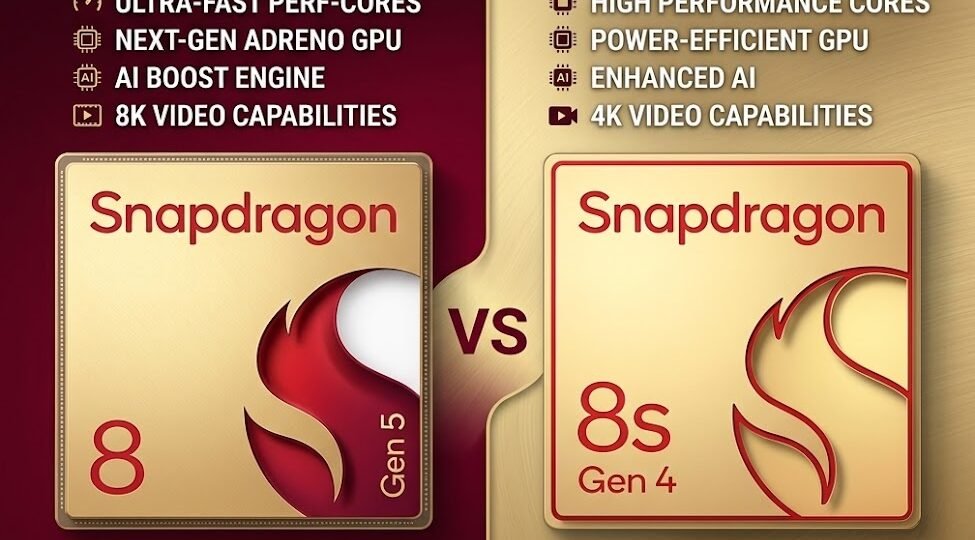
Snapdragon 8 Gen 5 vs. Snapdragon 8s Gen 4: An In-Depth Comparison of Next-Generation Mobile Performance(2026)
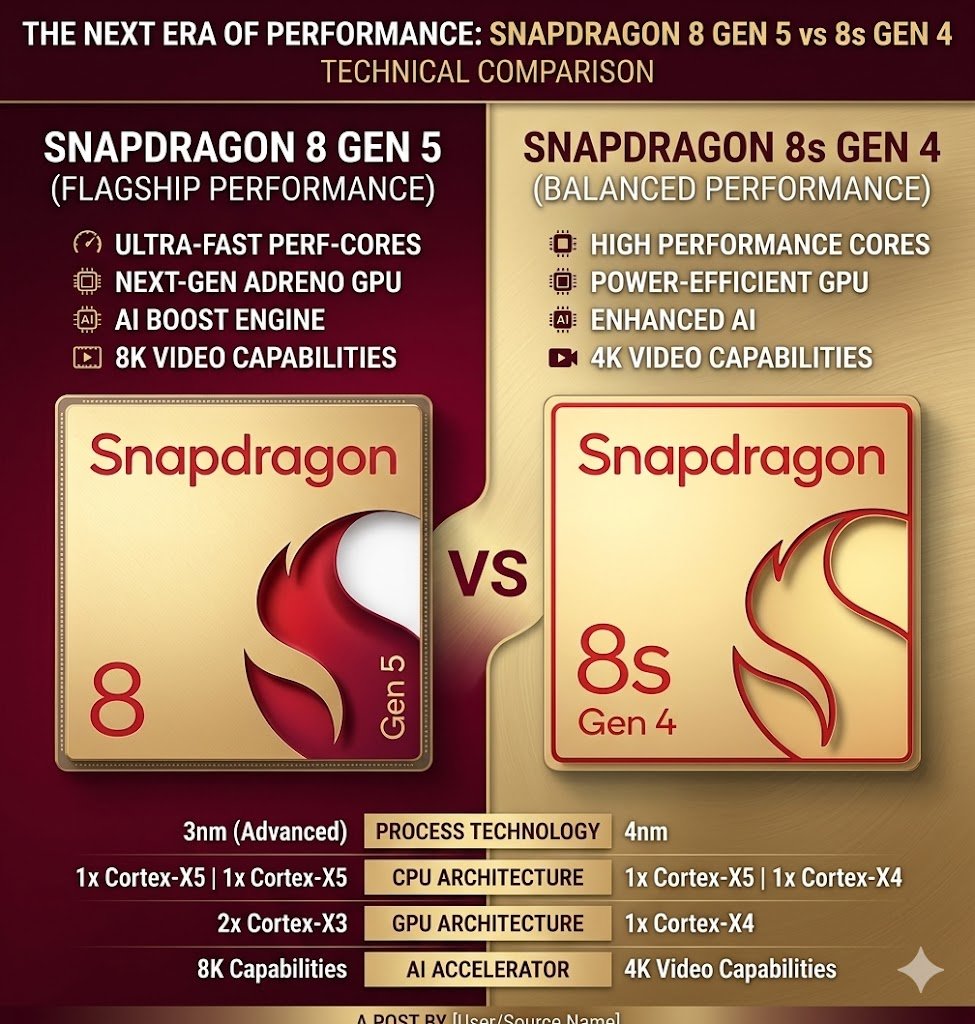

Compare the Qualcomm Snapdragon 8 Gen 5 and Snapdragon 8s Gen 4 in this 1800-word guide. Explore Oryon CPU architecture, 3nm efficiency, high-performance graphical task benchmarks, and top smartphones for 2026.
Table of Contents
- The Evolution of Qualcomm’s Flagship Tiers
- Architectural Foundations: TSMC 3nm vs. 4nm Process
- CPU Revolution: The Transition to 3rd-Gen Oryon Cores
- Benchmark Analysis: Raw Processing Power Showdown
- Visual Excellence: Adreno 840 vs. Adreno 825 in Graphical Tasks
- Edge Intelligence: Agentic AI and the Hexagon NPU
- Imaging and Multimedia: 20-bit Spectra ISP vs. 18-bit Spectra
- Next-Gen Connectivity: X80 vs. X75 5G Modems
- Detailed Technical Specifications Table
- Pros and Cons of Each Chipset
- Market Adoption: Devices Featuring These Chipsets
- Frequently Asked Questions (FAQs)
- Final Verdict: Which Processor Defines the Future?
1. The Evolution of Qualcomm’s Flagship Tiers
The mobile processing landscape witnessed a seismic shift between late 2025 and early 2026. Qualcomm strategically expanded its portfolio to bridge the performance gap between “standard” high-end devices and ultra-premium elite models. The Snapdragon 8 Gen 5, unveiled in November 2025, represents a massive leap for the core series by incorporating custom architectures previously exclusive to the “Elite” tier.
In contrast, the Snapdragon 8s Gen 4, released in April 2025, serves as a “light” flagship—designed to deliver premium power at a price point more accessible to the mass market. While both processors are designed for heavy workloads, the technical divide between them is substantial. This article provides a comprehensive analysis to determine if the newer Gen 5 architecture justifies the investment for users focused on visuals and high-performance graphical tasks.
2. Architectural Foundations: TSMC 3nm vs. 4nm Process
The most significant differentiator in efficiency lies in the manufacturing node. The Snapdragon 8 Gen 5 is built on TSMC’s cutting-edge 3nm (N3P) process. In semiconductor design, a smaller nanometer node allows for higher transistor density, which directly translates to improved power saving and superior thermal management.
The Snapdragon 8s Gen 4 utilizes the older, though highly reliable, TSMC 4nm process. While 4nm technology is incredibly capable, it cannot match the sheer efficiency of the 3nm node. The Gen 5’s move to 3nm enables the chip to perform more complex calculations for longer durations without significant thermal throttling, making it the superior choice for sustained high-intensity workloads.
3. CPU Revolution: The Transition to 3rd-Gen Oryon Cores
The primary narrative of this comparison is the fundamental shift in CPU design.
- Snapdragon 8 Gen 5: This chipset abandons standard ARM cores in favour of Qualcomm’s custom 3rd-gen Oryon CPU cores. These cores, originally developed for desktop-level performance, are now fully optimized for mobile platforms. The configuration features two Prime cores clocked at a remarkable 3.8 GHz and six performance cores at 3.32 GHz.
- Snapdragon 8s Gen 4: This processor remains on the Kryo architecture, utilizing standard ARM Cortex designs. It features a single Cortex-X4 core at 3.21 GHz, supported by several Cortex-A720 cores in a more traditional “big-core” setup.
By implementing Oryon cores, the Snapdragon 8 Gen 5 provides a level of “snappiness” in user interface animations and application load times that the 8s Gen 4 cannot duplicate.
4. Benchmark Analysis: Raw Processing Power Showdown
Benchmark results illustrate the clear performance hierarchy established by Qualcomm’s engineering.
Geekbench 6 Performance
In raw CPU testing, the Snapdragon 8 Gen 5 significantly outpaces the 8s Gen 4.
- Single-Core: The 8 Gen 5 averages a score of 2,921, while the 8s Gen 4 settles near 2,158. This represents an approximate 35% lead in single-threaded tasks.
- Multi-Core: The disparity increases here, with the 8 Gen 5 reaching 9,753 compared to the 8s Gen 4’s 6,989. This constitutes a massive 40% increase in multi-threaded processing capability.
AnTuTu V11 Performance
- Snapdragon 8 Gen 5: Recent reports suggest this chip can score between 3 million and 3.4 million points.
- Snapdragon 8s Gen 4: Generally hovers between 2.1 million and 2.4 million points.
In summary, the Snapdragon 8 Gen 5 delivers a 25% to 40% boost in overall system performance over the “light” flagship variant.
5. Visual Excellence: Adreno 840 vs. Adreno 825 in Graphical Tasks
For professionals and enthusiasts engaging in high-performance graphical tasks, the GPU is the most vital component.
- Snapdragon 8 Gen 5 (Adreno 840): This GPU shares its architecture with the ultra-flagship 8 Elite Gen 5, though with a optimized number of processing units to balance cost. It supports hardware-accelerated ray tracing and advanced Snapdragon Elite features for superior visual fidelity.
- Snapdragon 8s Gen 4 (Adreno 825): While it also supports modern visual standards and ray tracing, the Adreno 825 is roughly 22% slower than the Adreno 840.
In intensive scenarios like rendering high-resolution textures or processing complex 3D environments, the Snapdragon 8 Gen 5 ensures higher frame rate stability and less power consumption during long sessions of high-performance graphical tasks.
6. Edge Intelligence: Agentic AI and the Hexagon NPU
Artificial Intelligence is the defining technological pillar of 2026. Both chipsets utilize the Qualcomm Hexagon NPU, but the Gen 5 moves toward more autonomous processing.
- Agentic AI: The Snapdragon 8 Gen 5 supports “agentic” on-device AI, allowing for complex decision-making and task automation without relying on a cloud connection. It includes hardware matrix acceleration to speed up Large Language Model (LLM) processing directly on the smartphone.
- Total Performance: The Gen 5’s AI capabilities are estimated to be 46% higher than those of previous generations, facilitating more natural voice assistants and smarter environmental recognition.
7. Imaging and Multimedia: 20-bit Spectra ISP vs. 18-bit Spectra
The Image Signal Processor (ISP) dictates the quality of visual captures and video streams.
- Snapdragon 8 Gen 5 (20-bit Triple ISP): This processor supports 320MP camera sensors and is capable of 4K video recording at 120fps. It also features advanced semantic segmentation to improve the accuracy of portrait visual effects.
- Snapdragon 8s Gen 4 (18-bit Triple ISP): While still supporting 320MP photography, its video capabilities are restricted to 4K at 60fps.
For users who prioritize professional-grade video visuals, the Snapdragon 8 Gen 5 is the definitive winner due to its higher frame rate support and superior dynamic range processing.
8. Next-Gen Connectivity: X80 vs. X75 5G Modems
Connectivity specs ensure that the device remains relevant as network infrastructure evolves.
- Modem: The Snapdragon 8 Gen 5 integrates the X80 5G modem, which supports peak download speeds of 10 Gbps and offers full mmWave compatibility. The 8s Gen 4 uses the X75 modem, peaking at 4.2 Gbps and often lacking mmWave support in standard global configurations.
- Storage and Memory: The Gen 5 supports the faster UFS 4.1 storage standard, providing quicker file transfers and app installation. The 8s Gen 4 is limited to UFS 4.0. Both support LPDDR5X RAM up to 4800MHz.
9. Detailed Technical Specifications Table
| Feature | Snapdragon 8 Gen 5 | Snapdragon 8s Gen 4 |
|---|---|---|
| Launch Date | November 2025 | April 2025 |
| Manufacturing Process | TSMC 3nm (N3P) | TSMC 4nm (N4P) |
| CPU Type | 8-core 3rd-Gen Oryon | 8-core Kryo (ARM Cortex) |
| Peak Clock Speed | 3.8 GHz | 3.21 GHz |
| GPU Architecture | Adreno 840 | Adreno 825 |
| AI Processing | Hexagon (Agentic AI) | Hexagon NPU |
| ISP / Video | 20-bit (4K @ 120fps) | 18-bit (4K @ 60fps) |
| Max Download Speed | 10 Gbps (X80 Modem) | 4.2 Gbps (X75 Modem) |
| Storage Standard | UFS 4.1 | UFS 4.0 |
10. Pros and Cons of Each Chipset
Snapdragon 8 Gen 5
- Pros:
- Equipped with future-proof Oryon CPU architecture for extreme speed.
- 3nm process ensures peak energy efficiency and low heat generation.
- Ultra-fast 10 Gbps 5G connectivity for next-gen networks.
- Support for high-frame-rate 4K visuals at 120fps.
- Cons:
- Devices utilizing this chip will carry a higher initial market price.
- Slightly lower graphical peak compared to the “Elite” variant.
Snapdragon 8s Gen 4
- Pros:
- Provides excellent value-to-performance for premium-tier smartphones.
- More than sufficient power for heavy multitasking and daily productivity.
- Reliable sustained performance due to mature architecture.
- Cons:
- Significantly lower raw CPU scores compared to the Gen 5 series.
- Older 4nm process results in less power-efficiency for extreme tasks.
- Lacks the ultra-high frame rate video visuals of the newer chip.
11. Market Adoption: Devices Featuring These Chipsets
Based on manufacturer announcements and industry data, the following models are key adopters of these technologies:
- Snapdragon 8 Gen 5 Models:
- OnePlus 15R: The first major release to utilize this chipset.
- OnePlus Ace 6 Pro Max: Rumoured to feature a high-refresh OLED panel with this chip.
- Vivo X300 FE: The global brand for the S50 Pro Mini, opting for Gen 5 power.
- Oppo K15 Turbo Pro: A performance-focused model utilizing Gen 5 for high-load visuals.
- Snapdragon 8s Gen 4 Models:
- iQOO Z10 Turbo Pro: A leading model for balanced flagship performance.
- iQOO Neo 10: Known for high stability and value.
- Poco F7: A popular choice for high-end specs at a mid-range price.
- Redmi Turbo 4 Pro: Xiaomi’s primary vehicle for the 8s Gen 4 platform.
12. Frequently Asked Questions (FAQs)
Q: Is the Snapdragon 8 Gen 5 superior to the Snapdragon 8 Elite? A: No. The Snapdragon 8 Elite remains the top-tier “Ultimate Edition” flagship. The 8 Gen 5 is positioned just below it, sharing architecture but offering slightly lower peak performance to be more cost-effective.
Q: Can the Snapdragon 8s Gen 4 handle intensive high-performance graphical tasks? A: Yes. It is more than capable of running modern 3D rendering tasks and high-fidelity visuals. However, the Snapdragon 8 Gen 5 will provide higher frame rates and better power efficiency during extended sessions.
Q: Will I notice a difference in daily app usage? A: For social media and browsing, the difference is minimal. However, the Gen 5’s Oryon cores and UFS 4.1 storage make the device feel noticeably snappier when launching large files or processing on-device AI tasks.
Q: Does the 8s Gen 4 support the fastest 5G networks? A: While it supports 5G, it is often limited to Sub-6 GHz bands and peaks at 4.2 Gbps, whereas the Gen 5 includes robust mmWave support and 10 Gbps speeds.
13. Final Verdict: Which Processor Defines the Future?
The choice between the Snapdragon 8 Gen 5 and the Snapdragon 8s Gen 4 rests on your specific priorities.
If you are a power user, content creator, or visual professional who demands the fastest processing and high-performance graphical capabilities, the Snapdragon 8 Gen 5 is the undisputed choice. Its transition to the 3nm node, custom Oryon cores, and 4K 120fps visuals ensure it will remain a performance leader for years to come.
However, for those seeking a premium flagship experience without the peak price tag, the Snapdragon 8s Gen 4 remains a formidable contender. It provides more power than 95% of today’s applications require and offers an exceptional balance of features and affordability.
Focus Keyphrase: Snapdragon 8 Gen 5 vs Snapdragon 8s Gen 4 Tags: Qualcomm Snapdragon, Mobile Processors, Snapdragon 8 Gen 5, Snapdragon 8s Gen 4, Smartphone Benchmarks, Oryon CPU, Adreno GPU, OnePlus 15R, iQOO Neo 10, TSMC 3nm, High Performance Visuals.