
0
Why Apple’s A-Series Chips Lead in Efficiency
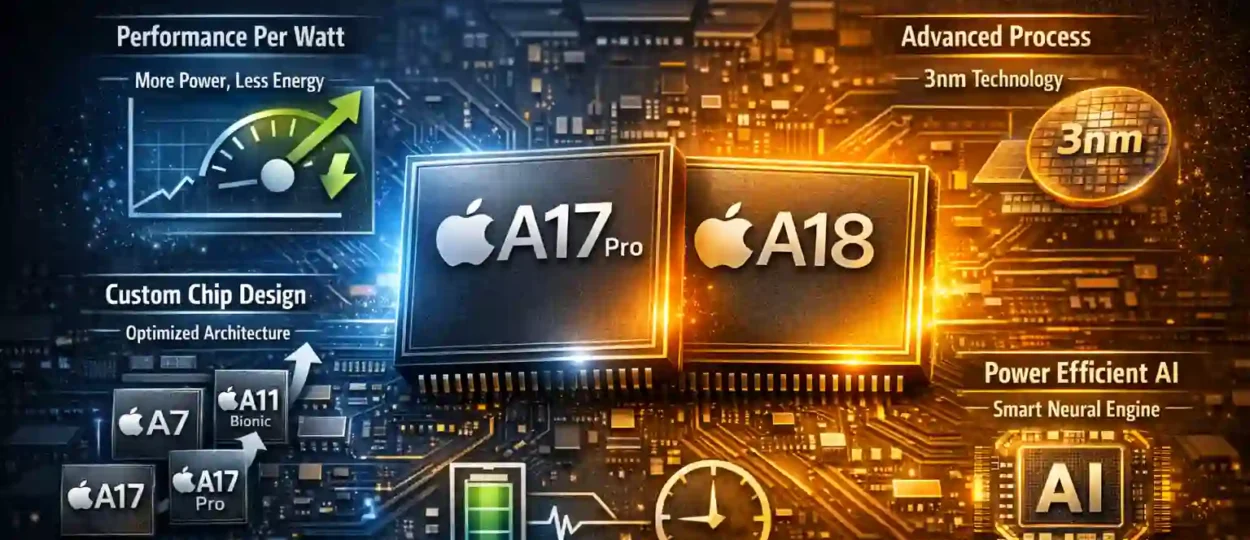
Apple’s A-series chips—like the Apple A7, Apple A11 Bionic, Apple A14 Bionic, and modern designs such as the Apple A17 Pro—have consistently set the benchmark for efficiency in mobile computing. While competitors often chase peak performance, Apple has mastered a far more important metric: performance per watt. This is the reason iPhones deliver smooth performance, long battery life, and sustained speed even years after release.
Let’s break down exactly why Apple leads in efficiency—and why this advantage has only widened over time.
1. What “Efficiency” Really Means in Mobile Chips
Efficiency isn’t just about low power consumption—it’s about doing more work with less energy.
At a technical level, efficiency =
Performance ÷ Power Consumption
A chip that scores high in benchmarks but drains battery quickly is inefficient. Apple’s A-series chips stand out because they:
- Deliver high single-core performance
- Maintain low power draw
- Sustain performance over long periods without overheating
This balance is what makes Apple silicon unique.
2. Full Vertical Integration: Apple’s Biggest Advantage
Unlike most chipmakers, Apple Inc. controls the entire ecosystem:
- Hardware (iPhone, iPad)
- Operating system (iOS)
- Chip design (A-series silicon)
This vertical integration allows Apple to optimize everything together.
Why this matters:
- iOS is built specifically for Apple chips
- The chip is designed for real-world usage patterns
- No unnecessary overhead or compatibility layers
By contrast, Android chipmakers must design processors for a wide range of devices and software environments, which reduces efficiency.
3. Custom CPU Architecture (Cyclone to Modern Cores)
Apple does not use standard ARM cores like many competitors. Instead, it designs its own custom cores.
Example:
The Apple A7 introduced:
- Cyclone architecture
- First 64-bit ARMv8 implementation in mobile
This was a massive leap—not just in performance, but in efficiency.
Why custom cores matter:
- Wider execution pipelines
- Better instruction scheduling
- Higher IPC (Instructions Per Clock)
Result:
Apple achieves desktop-class performance at mobile power levels
4. Big.LITTLE Done Right (Performance + Efficiency Cores)
Modern A-series chips use a hybrid architecture:
- High-performance cores → heavy tasks
- Efficiency cores → background/light tasks
This concept exists in Android chips too, but Apple executes it better.
Apple’s advantage:
- Faster switching between cores
- Smarter task scheduling
- Better workload prediction
This means:
- Your phone uses minimal power for simple tasks
- Maximum power only when needed
5. Industry-Leading Single-Core Performance
Apple consistently dominates single-core benchmarks.
Why is this important?
Most everyday tasks depend on single-core performance:
- App launching
- UI responsiveness
- Browsing
- System animations
Instead of adding more cores, Apple focuses on:
- Faster cores
- Smarter execution
This approach is far more efficient than brute-force multi-core scaling.
6. Advanced Semiconductor Manufacturing (3nm Leadership)
Apple is always first to adopt cutting-edge fabrication processes from TSMC.
Timeline:
Smaller nodes bring:
- Lower power leakage
- Higher transistor density
- Better thermal efficiency
This is a major reason why newer A-series chips deliver:
- More performance
- Less battery drain
7. Tight Hardware–Software Optimization
Because Apple controls iOS, it can optimize deeply:
Examples:
- Apps compiled specifically for Apple silicon
- Metal API optimized for Apple GPUs
- Efficient memory management
This reduces:
- CPU workload
- Power consumption
Even with smaller batteries, iPhones often outperform competitors in battery life tests.
8. High-Performance GPU with Low Power Draw
Apple designs its own GPUs instead of relying on external vendors.
From:
- PowerVR GPU in Apple A7
to - Fully custom GPU in Apple A17 Pro
Benefits:
- Optimized for iOS rendering
- Efficient graphics pipelines
- Lower heat generation
This results in:
- Smooth visuals
- Consistent performance
- Better battery life during intensive tasks
9. Neural Engine & Specialized Accelerators
Apple includes dedicated hardware blocks:
- Neural Engine (AI processing)
- Image Signal Processor (ISP)
- Video encoders/decoders
Instead of using CPU/GPU for everything, Apple offloads tasks.
Example:
Face recognition → Neural Engine
Photo processing → ISP
This dramatically improves efficiency because:
- Specialized hardware uses less power
- Tasks are completed faster
10. Memory Architecture Efficiency
Apple uses a unified and tightly optimized memory system.
Benefits:
- Lower latency
- Reduced power usage
- Faster data access
Unlike fragmented memory systems in some devices, Apple ensures:
- CPU, GPU, and Neural Engine share memory efficiently
11. Thermal Efficiency & Sustained Performance
Many chips deliver high performance briefly but throttle quickly.
Apple chips:
- Generate less heat
- Sustain performance longer
Why?
- Efficient core design
- Advanced node process
- Smart power management
This leads to:
- Stable performance over time
- No sudden slowdowns
12. Real-World Optimization vs Benchmark Chasing
Some chipmakers optimize for benchmark scores.
Apple focuses on:
- Real-world performance
- Everyday usage
This includes:
- App opening speed
- Multitasking smoothness
- Camera processing
Result:
Even if benchmarks look similar, Apple devices feel faster.
13. Longevity & Software Support
Apple’s efficiency extends device lifespan.
Devices powered by chips like:
continue to perform well years later.
Why?
- Efficient architecture
- Optimized OS updates
- Strong single-core performance
This reduces:
- Need for frequent upgrades
- Electronic waste
14. Comparison with Android Chipmakers
Qualcomm (Snapdragon)
- Strong multi-core performance
- Higher power consumption
- Less OS-level optimization
MediaTek
- Competitive pricing
- Efficiency improving
- Still behind Apple in high-end optimization
Samsung Exynos
- Historically weaker efficiency
- Thermal issues in some generations
Key difference:
Apple designs everything together
Others rely on multiple vendors
15. The Efficiency Flywheel Effect
Apple’s advantage compounds over time:
- Better chips → better iOS optimization
- Better optimization → more efficient apps
- More efficient apps → better battery life
- Better battery life → improved user experience
This creates a feedback loop competitors struggle to match.
16. Case Study: Apple A7 – The Turning Point
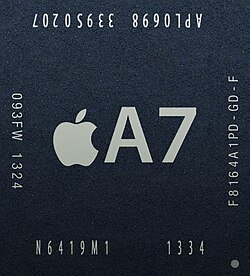
The Apple A7 was a historic breakthrough.
Key innovations:
- First 64-bit mobile chip
- Cyclone architecture
- Desktop-class performance per watt
Impact:
- Forced entire industry to move to 64-bit
- Redefined mobile efficiency standards
Even today, its design philosophy lives on in modern chips.
17. Case Study: Apple A17 Pro – Modern Efficiency King

The Apple A17 Pro showcases Apple’s current leadership.
Highlights:
- 3nm process
- Advanced GPU architecture
- Improved Neural Engine
Result:
- Massive performance gains
- Lower power consumption
- Industry-leading efficiency
18. Why Efficiency Matters More Than Raw Power
Efficiency directly impacts:
1. Battery Life
More efficient chips = longer usage time
2. Heat
Lower power = less heat
3. Performance Stability
No throttling = consistent speed
4. User Experience
Smooth, lag-free operation
Apple excels in all four.
19. Future of Apple A-Series Efficiency
Looking ahead, Apple will likely focus on:
- 2nm and beyond fabrication
- More AI acceleration
- Further CPU/GPU integration
- Even better power management
The gap between Apple and competitors may continue to grow.
20. Final Verdict
Apple’s dominance in efficiency is not accidental—it’s the result of:
- Full ecosystem control
- Custom architecture
- Advanced manufacturing
- Deep optimization
- Smart workload distribution
While competitors may match or exceed Apple in raw specs, no one consistently matches Apple’s performance-per-watt leadership.
Conclusion
From the groundbreaking Apple A7 to the cutting-edge Apple A17 Pro, Apple has built a reputation for efficiency that defines the modern smartphone experience.
In a world where battery life, sustained performance, and real-world speed matter more than ever, Apple’s approach proves one thing:
Efficiency isn’t just a feature—it’s the foundation of great computing.
WA