
0
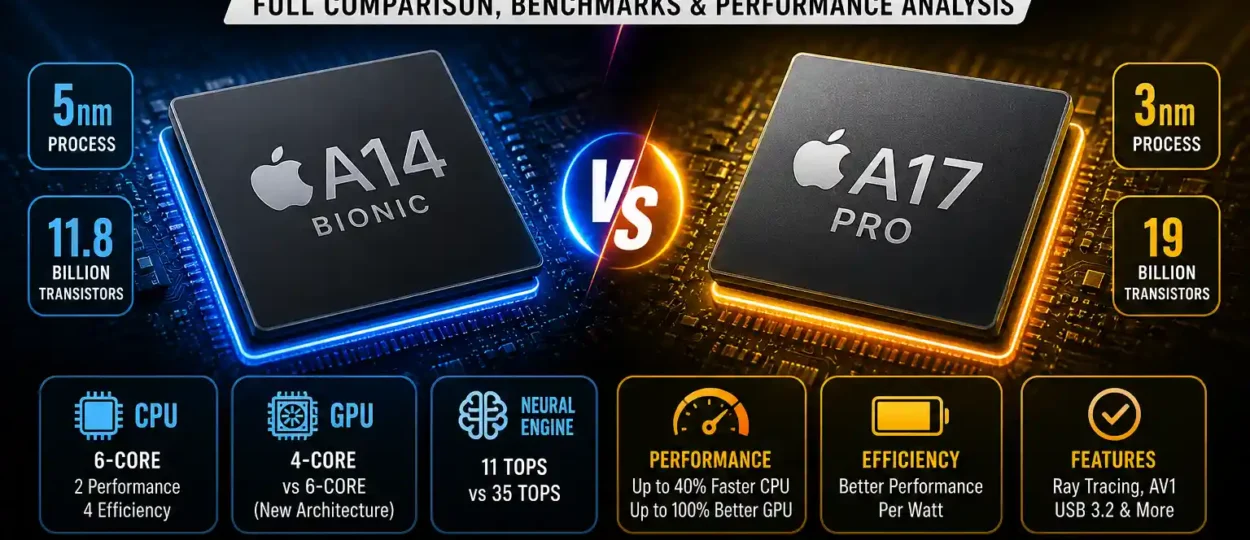
Apple A14 Bionic vs Apple A17 Pro
Apple A14 Bionic vs Apple A17 Pro: Full Comparison, Benchmarks, Performance & Which One is Better?
Introduction
The evolution of mobile processors has accelerated dramatically over the past few years, and no company has pushed boundaries quite like Apple Inc.. From the industry-first 5nm chipset to cutting-edge 3nm silicon, Apple continues to redefine smartphone performance.
Two important milestones in this journey are the Apple A14 Bionic and the Apple A17 Pro.
- The A14 Bionic (2020) introduced 5nm architecture
- The A17 Pro (2023) introduced 3nm performance and next-gen GPU
But how big is the real-world difference?
In this detailed comparison, we break down:
- CPU and GPU performance
- Benchmarks (AnTuTu, Geekbench, 3DMark)
- AI capabilities
- Power efficiency
- Real-world usage
- Long-term value
Overview of Apple A14 Bionic
The Apple A14 Bionic was a revolutionary chip at launch, becoming the first mass-produced 5nm SoC.
Key Specs:
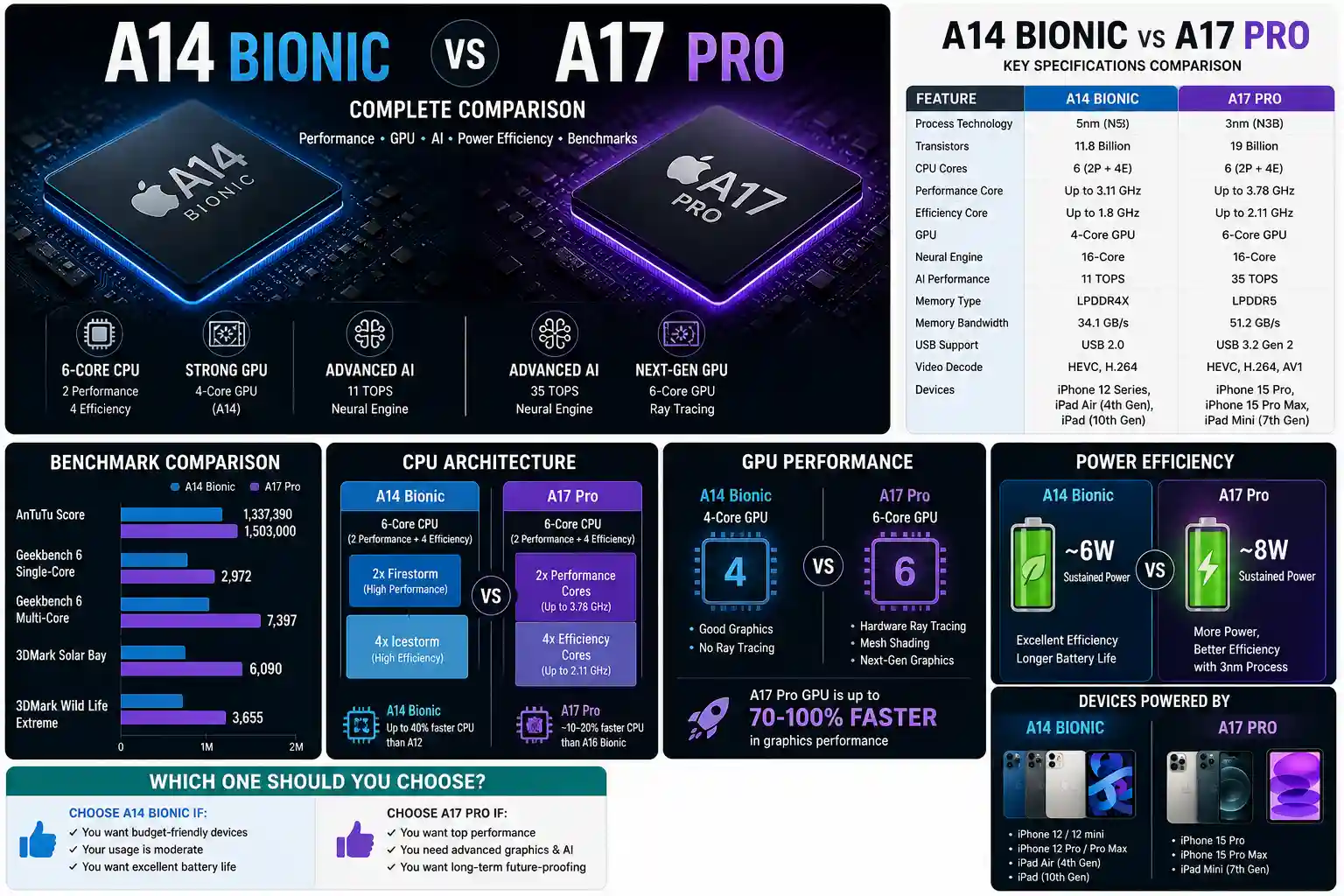
- 6-core CPU (2 Firestorm + 4 Icestorm)
- Clock speed: up to 3.1 GHz
- 4-core GPU
- 16-core Neural Engine (11 TOPS)
- 11.8 billion transistors
- LPDDR4X RAM support
Key Strengths:
- Excellent efficiency
- Strong single-core performance
- Reliable long-term stability
It powers devices like:
- iPhone 12
- iPhone 12 Pro Max
- iPad Air (4th generation)
Overview of Apple A17 Pro
The Apple A17 Pro represents a major leap forward in Apple silicon.
Key Specs:
- 6-core CPU (2 performance + 4 efficiency)
- Clock speed: up to 3.78 GHz
- 6-core GPU (new architecture)
- Neural Engine: 35 TOPS
- 19 billion transistors
- 3nm process (TSMC N3B)
Major Upgrades:
- Hardware-accelerated ray tracing
- Mesh shading
- AV1 decoding
- USB 3.2 support
Devices using A17 Pro:
- iPhone 15 Pro
- iPhone 15 Pro Max
Architecture Comparison
Manufacturing Process
| Feature | A14 Bionic | A17 Pro |
|---|---|---|
| Process | 5nm | 3nm |
| Transistors | 11.8B | 19B |
Analysis:
The A17 Pro’s 3nm process delivers:
- Better efficiency
- Higher transistor density
- Improved performance per watt
CPU Architecture
| Feature | A14 Bionic | A17 Pro |
|---|---|---|
| Cores | 6 | 6 |
| Performance cores | 2 | 2 |
| Efficiency cores | 4 | 4 |
| Max clock | 3.1 GHz | 3.78 GHz |
Real Difference:
- A17 Pro is ~10–20% faster in CPU tasks
- Better IPC improvements
- More efficient scheduling
Benchmark Comparison
AnTuTu Benchmark
| Chip | Score |
|---|---|
| A14 Bionic | ~1,337,000 |
| A17 Pro | ~1,503,000 |
Insight:
- ~12–15% overall improvement
- GPU and UX contribute most gains
Geekbench 6
| Test | A14 Bionic | A17 Pro |
|---|---|---|
| Single-Core | ~2124 | ~2972 |
| Multi-Core | ~4871 | ~7397 |
Analysis:
- A17 Pro is ~40% faster single-core
- ~50% faster multi-core
This directly affects:
- App speed
- Rendering
- Processing tasks
3DMark Graphics Performance
Verdict:
GPU improvement is massive:
- ~70–100% better graphics performance
GPU Comparison (Biggest Upgrade)
A14 GPU:
- 4-core GPU
- No ray tracing
- Solid but limited
A17 Pro GPU:
- 6-core redesigned GPU
- Hardware ray tracing
- Mesh shading
Real-World Impact:
- More realistic lighting
- Faster rendering
- Better sustained performance
👉 This is the biggest upgrade in the A17 Pro
AI & Machine Learning
Improvement:
- 3x faster AI processing
Benefits:
- Faster image processing
- Better voice recognition
- Improved AI tasks
Power Efficiency
A14 Bionic:
- Extremely efficient
- Lower power consumption (~6W)
- Excellent battery life
A17 Pro:
- More powerful but slightly higher power draw (~8W)
- Still efficient due to 3nm
Verdict:
- A14 = better efficiency per workload
- A17 Pro = better performance per watt
Memory & Bandwidth
Result:
- Faster app loading
- Better multitasking on A17 Pro
Multimedia & Features
A14:
- 4K video support
- HEVC, H.264
A17 Pro:
- AV1 decoding
- USB 3.2
- Advanced ISP
Result:
A17 Pro is more future-proof.
Real-World Usage Comparison
Daily Use
Both chips handle:
- Social media
- Browsing
- Streaming
- Multitasking
Difference:
- A17 Pro feels faster in heavy apps
Heavy Workloads
A17 Pro wins in:
- Video editing
- Rendering
- High-performance apps
Longevity
- A14: still usable in 2026
- A17 Pro: future-proof till 2030+
Pros and Cons
Apple A14 Bionic
Pros:
✔ Excellent efficiency
✔ Stable performance
✔ Still usable in 2026
Cons:
✖ Older GPU
✖ Slower AI
Apple A17 Pro
Pros:
✔ Massive GPU upgrade
✔ Strong CPU performance
✔ Advanced features
✔ Future-proof
Cons:
✖ Slightly higher power usage
✖ Expensive devices
Final Verdict: Which One Should You Choose?
Choose A14 Bionic if:
- You want budget-friendly performance
- You use older iPhones
- Your usage is moderate
Choose A17 Pro if:
- You want top-tier performance
- You need advanced graphics
- You want long-term future-proofing
Conclusion
The Apple A14 Bionic was a groundbreaking chip that introduced 5nm technology and set new efficiency standards.
However, the Apple A17 Pro represents a major generational leap, especially in:
- GPU performance
- AI processing
- Feature set
Final Comparison Summary:
👉 The A17 Pro is clearly superior, but the A14 still holds strong for everyday usage.
FAQ Section (for SEO)
Q1: Is A17 Pro much faster than A14 Bionic?
Yes, especially in GPU and AI tasks, with up to 2x performance improvement.
Q2: Is A14 Bionic outdated in 2026?
No, it still performs well for daily usage.
Q3: Which chip is better for long-term use?
A17 Pro is more future-proof.
Q4: What is the biggest difference?
The GPU upgrade and ray tracing support in A17 Pro.