
0
Apple A14 Bionic
Apple A14 Bionic: Complete Review, Benchmarks, Specifications & Performance Analysis
Introduction
The Apple A14 Bionic marked a major turning point in smartphone processor technology when it was launched on September 15, 2020. It became the first commercially available 5nm mobile chipset, setting a new benchmark for performance and efficiency in the industry.
Designed by Apple Inc. and manufactured by TSMC, the A14 Bionic powers devices like the iPhone 12 series and iPad Air (4th generation).
Even in 2025–2026, the A14 remains a highly capable chipset, offering strong CPU performance, excellent efficiency, and reliable real-world responsiveness.
This article provides a deep dive into:
- Architecture and design
- CPU, GPU, and AI performance
- Benchmark scores
- Power efficiency
- Real-world usage
- Comparison with newer chips
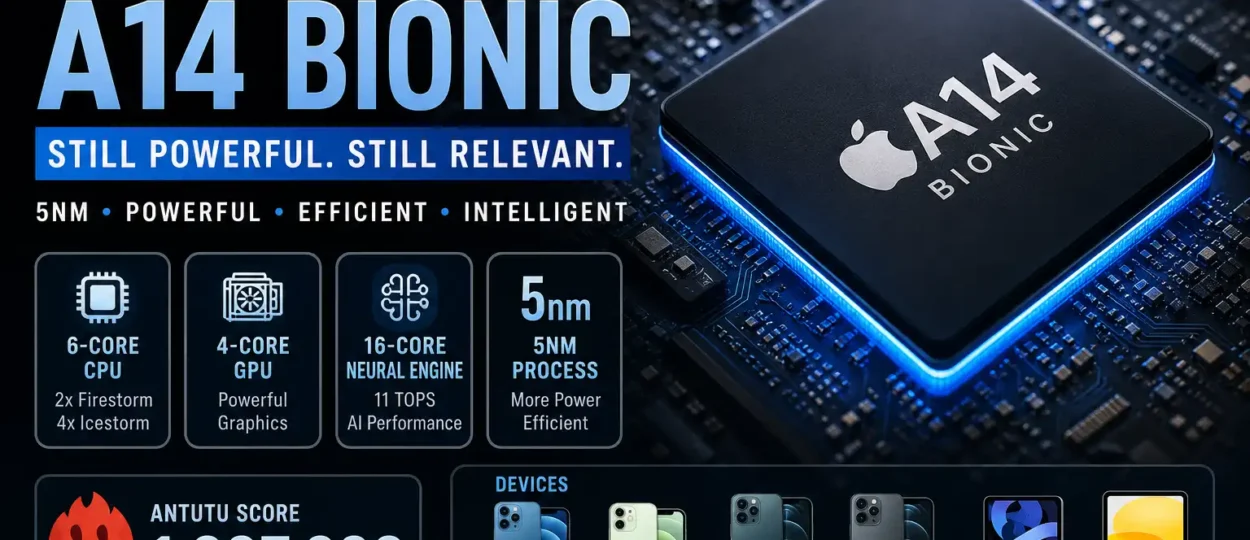
Apple A14 Bionic Overview
The Apple A14 Bionic is a 6-core System on a Chip (SoC) based on ARM architecture, featuring a balanced big.LITTLE configuration:
- 2 high-performance cores (Firestorm) up to 3.1 GHz
- 4 efficiency cores (Icestorm) up to 1.8 GHz
Key Highlights:
- 5nm process technology (TSMC N5)
- 11.8 billion transistors
- 4-core Apple GPU
- 16-core Neural Engine (11 TOPS)
- LPDDR4X memory support
- Strong power efficiency
At launch, Apple claimed:
- Up to 40% faster CPU performance vs A12
- Up to 30% faster GPU performance
Architecture & Design
5nm Breakthrough
The A14 Bionic was the first chip built on a 5nm process, a huge leap from the previous 7nm generation.
Benefits of 5nm:
- Higher transistor density
- Lower power consumption
- Better thermal efficiency
With 11.8 billion transistors, the A14 significantly improved computational capability while maintaining efficiency.
CPU Architecture (Firestorm & Icestorm)
The CPU uses a hybrid design:
| Core Type | Count | Clock Speed |
|---|---|---|
| Firestorm (Performance) | 2 | 3.1 GHz |
| Icestorm (Efficiency) | 4 | 1.8 GHz |
Performance Cores (Firestorm)
- Designed for heavy workloads
- High IPC (instructions per cycle)
- Strong single-core performance
Efficiency Cores (Icestorm)
- Handle background tasks
- Consume very low power
- Improve battery life
This architecture ensures:
- Fast responsiveness
- Smooth multitasking
- Efficient background processing
Cache Structure
The A14 includes a well-optimized cache system:
- L2 cache: 8MB (performance cores)
- L2 cache: 4MB (efficiency cores)
- System-level cache: 16MB
This reduces latency and improves memory access speed.
GPU Performance
The Apple A14 Bionic features a 4-core Apple-designed GPU.
Key Features:
- Improved rendering performance
- Efficient power usage
- Optimized Metal API support
Performance Improvements:
- ~30% faster than A12 GPU
- Strong performance in graphics workloads
Geekbench GPU Score:
- ~16,800 points
3DMark Performance:
- Solar Bay: 2768
- Wild Life Extreme: 2229
The GPU remains capable for:
- High-resolution rendering
- Video processing
- UI smoothness
Neural Engine & AI Capabilities
The A14 Bionic includes a 16-core Neural Engine capable of:
- 11 trillion operations per second (11 TOPS)
AI Improvements:
- Faster machine learning tasks
- Better image recognition
- Enhanced computational photography
Additionally, Apple introduced:
- Machine learning accelerators (AMX blocks)
- Improved AI efficiency
This enables:
- Real-time image processing
- Advanced camera features
- On-device AI computation
Benchmark Performance
AnTuTu Benchmark
- Total Score: ~1,337,390
- CPU: 385,010
- GPU: 319,009
- Memory: 162,732
- UX: 470,639
This places the A14 in the upper mid-range to flagship category, even today.
Geekbench 6
- Single-Core: ~2124
- Multi-Core: ~4871
These scores show:
- Strong single-core performance
- Moderate multi-core capabilities
Real-World Performance Tests
- HTML rendering: ~110 pages/sec
- PDF rendering: ~123 MPixels/sec
- Image detection: ~104 images/sec
These results indicate smooth performance in:
- Browsing
- Document handling
- Daily tasks
Power Efficiency
One of the biggest strengths of the A14 Bionic is efficiency.
Power Metrics:
- Sustained power: ~6W
- Excellent idle consumption
- High battery efficiency rating (~92 score)
Benefits:
- Longer battery life
- Less heat generation
- Stable sustained performance
Even compared to some newer chips, the A14 remains highly efficient.
Memory & Bandwidth
- Memory type: LPDDR4X
- Frequency: 2133 MHz
- Bandwidth: 34.1 GB/s
- Max RAM: 6GB
While not as fast as LPDDR5, it is:
- Efficient
- Sufficient for most tasks
- Well-optimized by Apple
Multimedia Capabilities
Video Support:
- 4K recording at 60 FPS
- HEVC and H.264 encoding
- Multiple decoding formats
ISP (Image Signal Processor):
- Improved computational photography
- Better HDR processing
- Enhanced low-light performance
Connectivity Features
- 5G support
- LTE Cat. 18
- Wi-Fi 6
- Bluetooth 5.0
- Multi-navigation system support
These features ensure:
- Fast connectivity
- Reliable wireless performance
Devices Powered by A14 Bionic
The A14 Bionic is used in:
- iPhone 12 Pro Max
- iPhone 12 Pro
- iPhone 12
- iPhone 12 mini
- iPad Air (4th generation)
- iPad (10th generation)
These devices still deliver:
- Smooth performance
- Long-term usability
- Strong ecosystem integration
Comparison with Apple A13 Bionic
| Feature | A13 Bionic | A14 Bionic |
|---|---|---|
| Process | 7nm | 5nm |
| CPU | Baseline | +40% |
| GPU | Baseline | +30% |
| AI | 8 TOPS | 11 TOPS |
| Transistors | 8.5B | 11.8B |
The A14 brought:
- Major efficiency improvements
- Better AI performance
- Higher transistor density
Comparison with Apple A17 Pro
| Feature | A14 Bionic | A17 Pro |
|---|---|---|
| Process | 5nm | 3nm |
| CPU | Older | +10–15% faster |
| GPU | 4-core | 6-core (redesigned) |
| AI | 11 TOPS | 35 TOPS |
| Transistors | 11.8B | 19B |
The A17 Pro is significantly more advanced, but the A14 still holds up well for everyday usage.
Real-World Usage Experience
In daily use, the A14 Bionic delivers:
- Smooth UI performance
- Fast app loading
- Stable multitasking
It handles:
- Social apps
- Streaming
- Editing tasks
- Productivity apps
Even in 2026, devices powered by A14 remain responsive and usable.
Pros and Cons
Pros:
✔ Strong single-core performance
✔ Excellent power efficiency
✔ Reliable long-term performance
✔ Solid GPU capabilities
Cons:
✖ Older architecture compared to newer chips
✖ Lower multi-core performance vs latest SoCs
✖ Limited to LPDDR4X memory
Longevity & Relevance in 2026
Despite being launched in 2020, the A14 Bionic remains:
- Efficient
- Stable
- Capable
It benefits from:
- Apple’s long software support
- Strong hardware-software integration
This makes it a great long-term chipset even today.
Final Verdict
The Apple A14 Bionic is a landmark processor that introduced 5nm technology to the mainstream smartphone market.
It combines:
- Strong CPU performance
- Efficient GPU
- Reliable AI processing
- Excellent power efficiency
While newer chips like the A17 Pro bring significant upgrades, the A14 still delivers solid performance for everyday use.
For users and developers alike, it remains a balanced and dependable mobile processor.
FAQ (SEO Section)
Q1: Is Apple A14 Bionic still good in 2026?
Yes, it still offers smooth performance for daily tasks and remains efficient.
Q2: What is the AnTuTu score of A14 Bionic?
It scores around 1.33 million in AnTuTu benchmarks.
Q3: Which phones use Apple A14 Bionic?
iPhone 12 series and iPad Air (4th generation).
Q4: How powerful is the A14 Neural Engine?
It delivers 11 TOPS of AI performance.