
0
Apple A13 Bionic
Apple A13 Bionic: Full Review, Benchmarks, Performance & Specs (2026 Guide)
Introduction
When Apple Inc. launched the Apple A13 Bionic in September 2019, it wasn’t just another yearly upgrade—it was a statement about performance efficiency, real-world speed, and long-term optimization. Even today, years after its release, the A13 Bionic continues to deliver reliable performance across millions of devices worldwide.
This chipset powered iconic devices like the iPhone 11, iPhone 11 Pro, and iPhone SE (2nd generation), and remains relevant even in 2026.
In this detailed guide, we will cover:
- Architecture and design
- CPU & GPU performance
- Benchmarks (AnTuTu, Geekbench, 3DMark)
- AI and Neural Engine
- Real-world usage
- Battery efficiency
- Pros, cons, and verdict
Apple A13 Bionic Overview
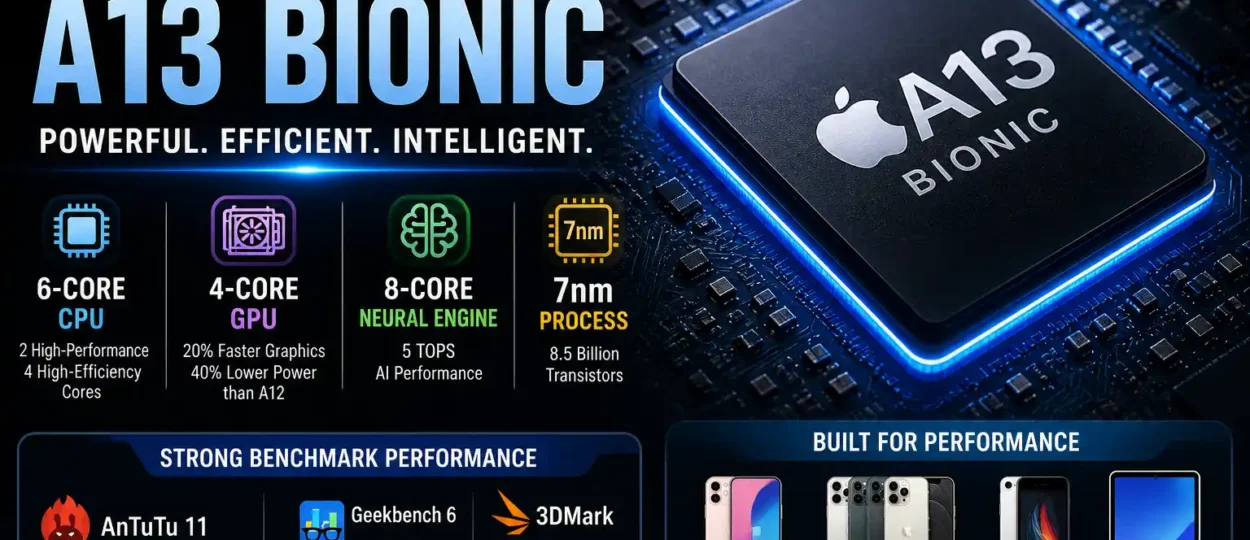
The Apple A13 Bionic is a 64-bit ARM-based system-on-chip (SoC) built on a 7nm process by TSMC. It features a balanced architecture that focuses on both high performance and energy efficiency.
Key Specifications:
- 6-core CPU (2 performance + 4 efficiency cores)
- Max clock speed: 2.65 GHz
- 4-core GPU
- 8-core Neural Engine
- 8.5 billion transistors
- 7nm (N7P) fabrication process
- LPDDR4X memory support
At launch, Apple claimed:
- 20% faster CPU performance vs A12
- 20% faster GPU performance
- Up to 30–40% improved efficiency
CPU Architecture & Performance
The A13 Bionic uses a hybrid CPU architecture:
Core Breakdown:
- 2x Lightning cores (Performance cores)
- Clocked up to 2.65 GHz
- Designed for heavy tasks
- 4x Thunder cores (Efficiency cores)
- Clocked at 1.6 GHz
- Handle background and low-power tasks
This design allows the chip to intelligently switch between power and efficiency depending on workload.
Real-World CPU Performance
The A13 Bionic delivers:
- Smooth multitasking
- Fast app launches
- Consistent performance under load
Even in 2026, it handles:
- Web browsing
- Social media apps
- Video streaming
- Productivity tasks
without noticeable lag.
Benchmark Performance
Benchmarks give us a measurable understanding of performance. Let’s break down the A13’s performance across major tests.
AnTuTu Benchmark
- Total Score: ~1,091,336
- CPU: 296,635
- GPU: 309,246
- Memory: 139,352
- UX: 346,103
Analysis:
The A13 still crosses 1 million+ score, which is impressive for a 2019 chipset.
Geekbench 6
- Single-Core Score: 1754
- Multi-Core Score: 4189
What This Means:
- Strong single-core performance
- Decent multi-core performance
- Optimized for iOS ecosystem
3DMark Graphics Tests
- Solar Bay: 2565
- Wild Life Extreme: 2001
Insight:
While newer chips outperform it, the A13 still holds up for demanding graphical workloads.
GPU Performance
The A13 Bionic features a 4-core Apple-designed GPU.
Improvements:
- 20% faster than A12 GPU
- 40% lower power consumption
Real-World Performance:
- Smooth graphics rendering
- Stable frame rates
- Good thermal control
Although it lacks advanced features like ray tracing, it still delivers consistent performance for modern applications.
AI & Neural Engine
The A13 includes an 8-core Neural Engine capable of:
- 5 trillion operations per second (5 TOPS)
Use Cases:
- Face recognition
- Image processing
- Voice assistants
- Real-time AI enhancements
Impact:
Even though newer chips offer higher AI performance, the A13 remains efficient and capable for everyday AI tasks.
Memory & Storage Support
- RAM: LPDDR4X
- Max RAM support: 4GB
- Storage: NVMe
Result:
- Smooth multitasking
- Fast data access
- Reliable performance
Power Efficiency & Battery Life
One of the biggest strengths of the A13 Bionic is efficiency.
Key Points:
- Built on 7nm process
- Optimized power management
- TDP around 6W
Battery Performance:
- Excellent standby time
- Efficient background processing
- Long-lasting usage
Devices like the iPhone 11 series are still known for their strong battery performance even today.
Real-World Performance (2026)
Daily Usage
The A13 Bionic easily handles:
- WhatsApp, Instagram, YouTube
- Chrome/Safari browsing
- Streaming (Netflix, Prime Video)
Heavy Tasks
- Photo editing: smooth
- Video editing (4K): manageable
- Multitasking: stable
Longevity
Despite being a 2019 chip:
✔ Still supported with modern iOS updates
✔ Reliable performance
✔ Optimized ecosystem
This shows Apple’s long-term software optimization advantage.
Devices Powered by A13 Bionic
The A13 Bionic is used in:
- iPhone 11
- iPhone 11 Pro Max
- iPhone SE (2nd generation)
- iPad (9th generation)
These devices are still widely used and perform reliably.
Pros and Cons
✅ Pros
✔ Excellent efficiency
✔ Strong single-core performance
✔ Stable long-term usage
✔ Great software optimization
✔ Still usable in 2026
❌ Cons
✖ Older GPU architecture
✖ Limited AI performance compared to newer chips
✖ No 5G support
✖ Limited RAM support
Apple A13 vs A14 vs A17 Pro (Quick Comparison)
| Feature | A13 | A14 | A17 Pro |
|---|---|---|---|
| Process | 7nm | 5nm | 3nm |
| Transistors | 8.5B | 11.8B | 19B |
| AI | 5 TOPS | 11 TOPS | 35 TOPS |
| GPU | 4-core | 4-core | 6-core |
| Performance | Good | Better | Best |
Is Apple A13 Bionic Still Good in 2026?
👉 Yes — for most users.
Ideal for:
- Daily usage
- Budget devices
- Students
- Casual users
Not ideal for:
- Heavy professional workloads
- Future-proof high-performance needs
Final Verdict
The Apple A13 Bionic is one of the most balanced chipsets Apple has ever made.
Even years after launch, it delivers:
- Reliable performance
- Excellent efficiency
- Strong real-world usability
While newer chips like A14 and A17 Pro have surpassed it, the A13 remains a solid and dependable processor in 2026.
Conclusion
The Apple A13 Bionic proves that performance isn’t just about raw power—it’s about efficiency, optimization, and longevity.
If you’re using an A13-powered device, there’s no urgent need to upgrade unless you want cutting-edge features.
FAQ Section (SEO Boost)
Q1: What is the AnTuTu score of Apple A13 Bionic?
Around 1.09 million points.
Q2: Is A13 Bionic good for daily use?
Yes, it handles everyday tasks smoothly.
Q3: Does A13 support 5G?
No, it only supports 4G LTE.
Q4: How powerful is A13 Neural Engine?
It delivers 5 TOPS AI performance.
Q5: Which phones use A13 Bionic?
iPhone 11 series and iPhone SE (2020).